Toolpath Division Interface
What You See
A dialog box labeled "Laminate 1, Ply 1," focusing on toolpath and motion path configuration. The "Toolpath Division Strategy" section lets you select a strategy from a dropdown menu, with "Uniform frame distance" shown, and a slider to set the frame distance. There's an "Apply" button to implement the chosen settings. Below, the "Motion path deviation from planned path" section displays statistical data for deviations: minimum, maximum, and mean distances in millimeters, alongside a "Refresh" button.
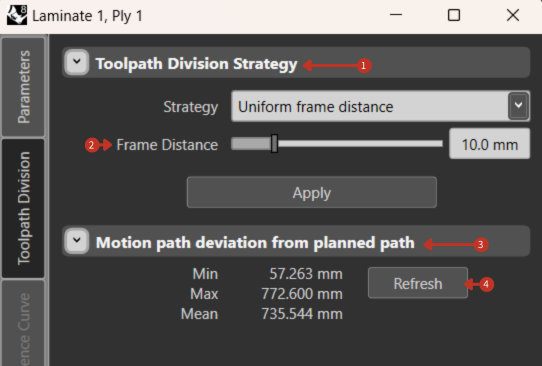
Toolpath division configuration with deviation analysis and strategy selection
What It Means
This interface provides critical tools for defining how a toolpath is divided and monitored during the fabrication process.
Division Strategy
-
"Toolpath Division Strategy": This setting allows the user to define how the toolpath is segmented into frames or sections, which can influence the precision and quality of the layup. The "Uniform frame distance" suggests a consistent separation between frames, essential for achieving a consistent quality of material deposition.
-
"Frame Distance": The slider adjusts the distance between frames along the toolpath, with precise control over the granularity of the layup process. This can affect the adaptability of the toolpath to the mold geometry and the overall layup time.
Deviation Analysis
-
"Motion path deviation from planned path": The presented values give insight into the variance between the actual motion path and the planned toolpath, essential for quality control. Such data is valuable for diagnosing issues in the layup process, such as machine calibration or material behavior.
-
"Refresh": By refreshing the motion path deviation data, the user can obtain real-time feedback on the accuracy of the layup process, enabling prompt adjustments to ensure the manufactured part adheres to design specifications.
Division Strategies
Common division strategies include:
- Uniform frame distance: Equal spacing between frames
- Adaptive: Variable spacing based on curvature
- Time-based: Frames at regular time intervals
- Feature-based: Frames at geometric features
Quality Metrics
Monitor deviation values:
- Minimum: Best-case deviation
- Maximum: Worst-case deviation
- Mean: Average deviation across path
- Acceptable tolerances typically < 1mm